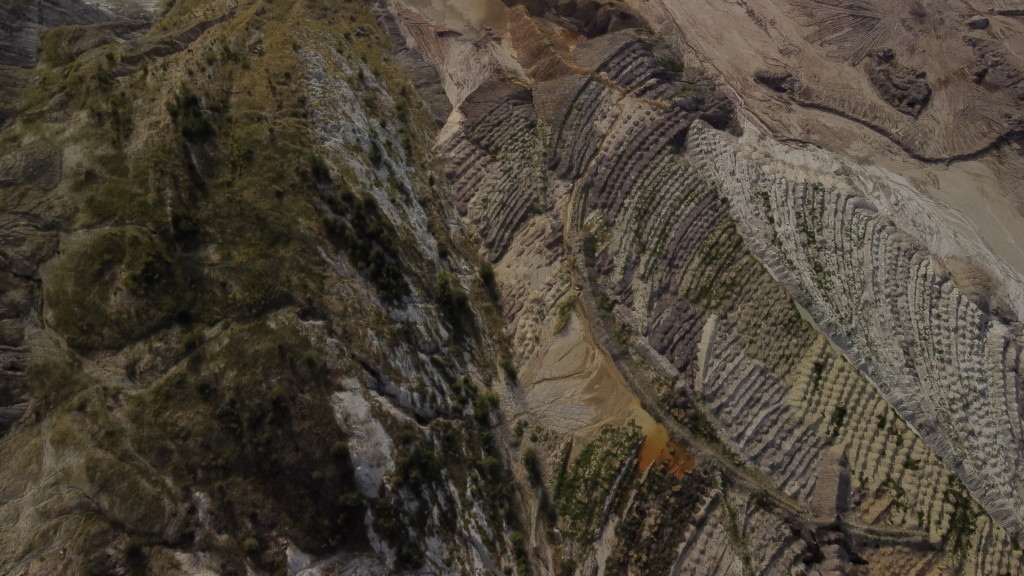
“coal”
video, 20min, 2024
My name „coal” (polish „Węgiel”) has caused me to wander the underground for years, exploring the nooks and crannies of mines in daydreams. Lately, the mine appears to me as a place with great potential. Encounters with a completely devastated place, penetrated 300 meters deep, turn out to be fascinating. I often visit an open pit mine visible from the moon. The cacaphony of stories coming out of this place is amazing. The inspiration for the video came from Adam Bobbette’s texts, among others. The first was “Spirituality of coal,” in which the author writes about how deeply coal has penetrated us, powering an electric reality. Bobbette argues that coal creates the spiritual self of modern man, and asks the question: how will our modern transition to post-coal societies result in a reconfiguration of the self? Another important text was “Mining is magical,” in which Bobbette tells the story of a community living around a sand mine in Java, whose „Making sacrifices, […] was a way of invoking and engaging the presence of spiritual beings. But these spirit beings were not just supernatural, spiritual entities – they were the spirits of ancestors or historical persons who once lived in the area of the mine; or historical figures of significance in Indonesian struggles against colonialism. In other words, these ghosts were stories that connected people to the land and to broader political and social narratives about the place. My friends who had to contend with the destruction of their rivers by sand mines were the first to teach me that ideas about ghosts in the mines were entirely contemporary, political and urgent. It was on the bridges, from which one could see the diggers working with front-end loaders and destroying the banks of the rivers, that I understood that definitions of what sand is are at stake. Is it an ancestral home that can make demands on you, to which you must make offerings and pay respect, or is it a dead, silent thing that can be exchanged for money? It was on these bridges that I also came to understand a disturbing truth about life in modern capitalism: not only is it fetishistic and animistic, it is also haunted. „At the very end of the world-at the mine site, I evoke the ghosts of the past, by impersonating human and non-human characters from forgotten old Polish klechdas, I evoke old stories. They fascinate me, they are non-linear, crazy, and the non-human characters have tremendous causality. As Anna Filipowicz writes in her article „To update the past. The “new animism as an indigenous ‘salvage perspective’”, with an animistic approach that goes beyond human perspectives, involves alternative ways of grasping subjectivity, the relationship between nature and culture, interspecies relationships, and the place of humans among other entities – animate and inanimate. This includes specific criteria of what is rational, in which parallelism of different perspectives is assumed; complementarity of both human and non-human points of view.”